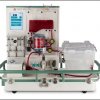
A human liver was kept alive outside a human being and then transplanted into a recipient patient who required a new liver, researchers from Oxford University and King's College Hospital reported. The scientists added that the procedure has been successfully performed on two patients who are currently recovering well.
The problem with current the transplantation method is organ damage after the donated liver is put "on ice", cooling it to slow its metabolism.
The new technology, which was developed by scientists at the University of Oxford, can preserve a fully-functioning liver outside the human body for a full-24 hours. The technology is being trialed as part of a controlled clinical investigation at the liver transplant center at King's College Hospital.
The team connected a donated human liver to the device, which is raised to 37 degrees celcius (98.6 farenheit), the temperature of the human body. Oxygenated red blood cells circulate through its capillaries. The liver functions normally once it is in the machine, just as it would inside our bodies, producing bile and regaining its color.
Device could help all liver transplant recipients
According to the results of the first two liver transplant procedures, which were performed at King's College Hospital last month, the device could help all patients on the waiting list for a new liver.
According to pre-clinical data, the device would also keep new donated livers 'viable' for much longer. The researchers believe the number of available organs would double if they could be preserved for 24 hours.
Co-inventor of the machine, Professor Constantin Coussios of Oxford University's Department of Engineering Science, and Technical Director of OrganOx, the University spin-out created to bring the device from the drawing board into the market, said:
"These first clinical cases confirm that we can support human livers outside the body, keep them alive and functioning on our machine and then, hours later, successfully transplant them into a patient. The device is the very first completely automated liver perfusion device of its kind: the organ is perfused with oxygenated red blood cells at normal body temperature, just as it would be inside the body, and can for example be observed making bile, which makes it an extraordinary feat of engineering.
It was astounding to see an initially cold grey liver flushing with color once hooked up to our machine and performing as it would within the body. What was even more amazing was to see the same liver transplanted into a patient who is now walking around. Whilst for these two transplants we only needed to keep the livers alive for up to 10 hours, in other experiments we have shown we can preserve a functioning liver and monitor its function outside the body for periods up to 24 hours."
Liver-preserving device would transform transplantation procedures
Consultant Liver Transplant Surgeon and Director of Transplant Surgery at King's College Hospital, Professor Nigel Heaton, explained that the fundamentals of liver transplantation have remained basically the same for decades, despite all the other astounding breakthroughs in modern medicine. This device, if it could be introduced into everyday practice, would completely change transplantation procedures.
The device would buy the surgeon extra time and widen the options for patients, many of whom would otherwise not survive as they wait for a suitable organ to become available.
Consultant Liver Transplant Surgeon at King's College Hospital, Mr Wayel Jassem, who performed both transplant operations, said "There is always huge pressure to get a donated liver to the right person within a very short space of time. For the first time, we now have a device that is designed specifically to give us extra time to test the liver, to help maximize the chances of the recipient having a successful outcome. This technology has the potential to be hugely significant, and could make more livers available for transplant, and in turn save lives."
The first recipient of a liver kept alive inside the device describes his experience
The first patient to receive a donated liver which was kept alive inside the device, Ian Christie, aged 62, said that he had been told in May 2012 that he had cirrhosis of the liver and could expect to live no more than 12 to 18 months if he did not receive a new liver.
He was placed on the waiting list, which for a liver of his type meant a wait of at least 12 to 18 months. Christie said "I was very worried it was cutting it a bit too fine and I wouldn't get a transplant."
Christie described the wait as "horrible". Sometimes his mind would drift from those horrible thoughts, but as soon as he caught sight of his traveling bag in the corner of his room, all packed and ready to go, he would remember.
He said he would be waiting for the phone to ring, wondering ''Are they ever going to call me? Are they ever going to call me? I took part in the trial because I just think it's the right thing to do. If the device can help more people in my situation in the future, it's my duty to help. I trusted that the doctors wouldn't go ahead with it unless they were absolutely sure so I knew there wasn't a risk to my transplant. Three days after the surgery, Mr Jassam from King's and the professors from Oxford arrived in my room with absolutely beaming smiles. They look like they are normally quite serious gentlemen so I knew it was a good sign to see them so pleased."
Christie says he feels better than he has felt for fifteen years, even taking into account the discomfort and pain from the healing wound. "I'm getting better and better day by day. I just feel so alive! 'It's so easy to get carried away and become euphoric, but things can still go wrong, so I'm trying to keep my feet on the ground and take it day by day."
Transplant surgery is a victim of its own success
Prof. Coussios, from Oxford University's Nuffield Department of Surgical Sciences, and Prof. Peter Friend, Director of the Oxford Transplant Centre, have been carrying out research on transplantation technology since 1994.
Prof. Friend describes transplant surgery as a victim of its own success. Demand for new organs is far greater than the supply. This device can help close this gap considerably, he added. Many transplant organs that are unusable with current techniques will become viable, allowing surgeons to help a much greater number of patients.
Prof Friend said:
"At present, organ transplantation depends upon cooling the organ to ice temperature to slow down its metabolism, but this does not stop it deteriorating and, if the organ is already damaged in some way, perhaps by being deprived of oxygen, then the combined effect can be disastrous. Many potential donor organs are declined as being unsuitable for this reason.
This new technique allows us to assess how well an organ is working before having to decide whether to commit a patient to the operation. So this technology promises to quality-assure organs which would otherwise be discarded. This would increase the number of transplants without increasing the risks. It will make a real difference to what happens to patients on the waiting list without requiring any change in current donation practices.
OrganOx, a company created by the University of Oxford
Spin-out company, OrganOx was formed in 2008, through Isis Innovation, Oxford's technology transfer company, in order to commercialize the Oxford research.
The device was developed by OrganOx for these initial clinical trials.
Dr. Les Russell, CEO of OrganOx, explained that in the US and Europe, approximately 13,000 liver transplant procedures are performed annually. It may sound like an impressive number, but there are 30,000 patients each year waiting for a suitable liver. Many of them die whilst awaiting transplantation.
More than 2,000 livers are thrown away each year because oxygen deprivation has damaged them, or they did not survive the cold preservation due to elevated intracellular fat.
King's College Hospital performs more than 2,000 transplants annually on children and adults. It is the largest liver transplant center in Europe.
source:medicalnewstoday
Human Liver Kept Alive Outside A Human Being - World First