
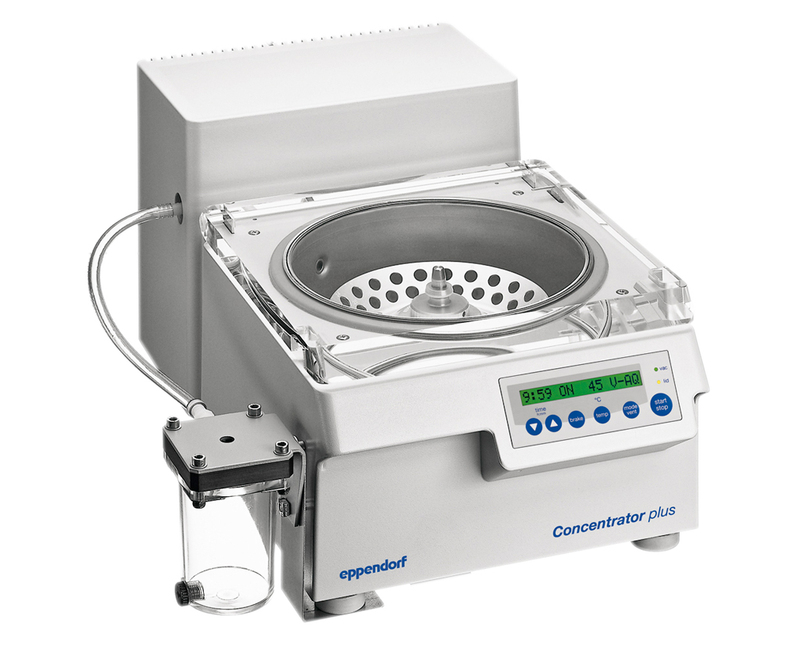

The new Concentrator plus from Eppendorf is available in two configurations:
- Complete system with an integrated service-free diaphragm pump
- Basic concentrator for connecting to an existing vacuum.
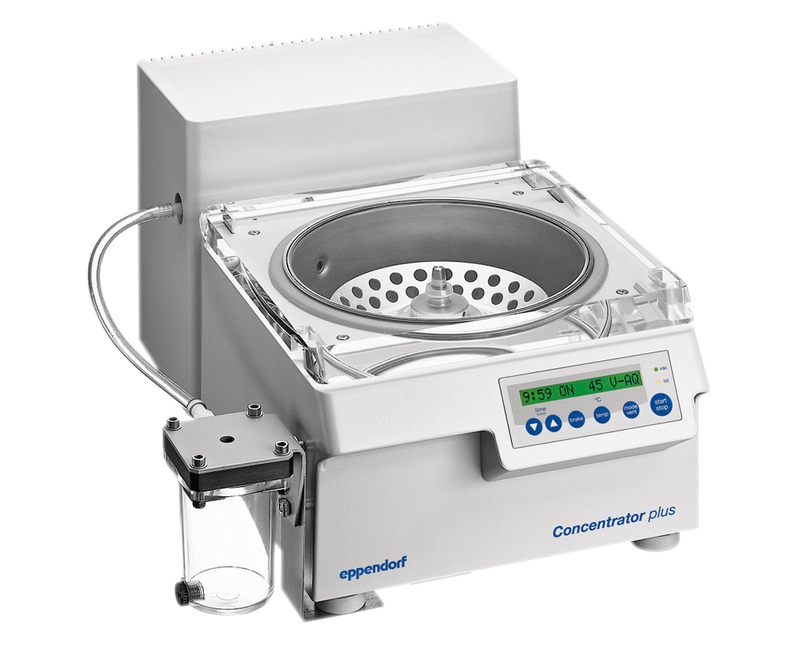
The concentrator can easily be upgraded to a complete system at a later stage if desired. Power to external vacuum pumps can be automatically controlled by using the AC receptacle in the rear of the concentrator.
The Concentrator’s heating technology optimizes the evaporation process. No matter which configuration you choose, you’re assured of quick and efficient—yet gentle—vacuum concentration of your samples (e.g. DNA/RNA, proteins).
The complete system includes a vapour condenser that purifies the exhaust air by up to 85%. This serves as protection against unpleasant vapours. At the same time, an automatic condensate drain extends the service life of all components that come into contact with the vapours.
The new Concentrator plus features a new LCD display and user-friendly control panel with clearly labeled function keys.
Product features:
- Narrow 32 cm width saves valuable bench space
- Chemical-resistant PTFE diaphragm pump
- Chemical-resistant stainless steel chamber
- Extremely quiet operation, even with pump turned on
- Choice of three application modes (aqueous, alcohol or high vapour pressure) to correspond with sample solvent → reduction of processing time up to 20%
- Choice of four heating levels (room temperature, 30 °C, 45° C, 60 °C) allows safe and efficient concentration of various samples
- Centrifugation and Desiccator function
Concentrator junction system
The Concentrator plus complete system adds extra flexibility with a junction for external devices. It allows you to use the integrated vacuum pump separately – without having to disconnect it from the system; simply connect the port to any external device that requires vacuum (e.g. gel dryer).
Rotor program
A wide range of fixed-angle rotors and the microplate rotor A-2-VC enable the Concentrator plus to be used for various applications in the laboratory