
Medtronic and the woes of America’s medical-technology industry
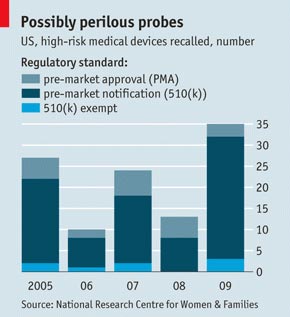 SCANDALS, recalls, stingy customers, anxious regulators—any one of these would traumatise a chief executive. America’s industry for medical devices is suffering from all of them. Omar Ishrak, the new boss of Medtronic, the world’s biggest medical-technology company, recently described the problem succinctly to analysts: “There is a lot of work ahead of us.”
This is a relatively new ailment for the industry. From 1998 to 2005 the use of equipment such as defibrillators and drug-eluting stents expanded rapidly. “It was the age of implantation in this country,” explains David Lewis of Morgan Stanley, with companies “sticking things into everybody.” Much has changed.
America’s new health-care law includes a 2.3% tax on medical devices, but this is trivial compared with other shifts. Health plans are forcing patients to pay a larger share of costs, so those who do not need a device urgently are slow to buy them, says Matthew Dodds of Citigroup. Firms used to boost sales by wooing doctors, but doctors are now increasingly employed by hospitals and companies themselves are adopting stricter ethics rules. Meanwhile the pressure on prices is only growing more intense. Hospitals, squeezed by lower government payments, are squeezing companies in turn, refusing to pay more for a new product that is only slightly better than the old version.
Unfortunately firms have not had much else to offer. Like Big Pharma, which introduced many “me too” drugs, device companies have sustained themselves by making small improvements to existing products. Spending on R&D has so far failed to yield many truly innovative devices, says Mr Lewis.
On top of all that, a brawl over regulation continues. Stephen Ubl of the Advanced Medical Technology Association, a business lobby, contends that the Food and Drug Administration (FDA) is restricting innovation; he points to a decline in approvals over the past five years. Others argue that the FDA’s rules are too lax.
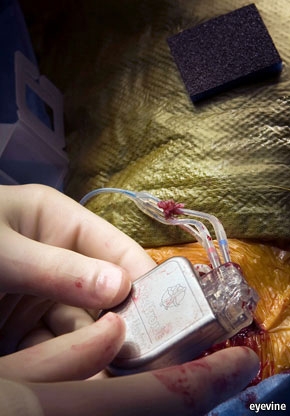
No company illustrates how all these trends have affected the industry better than Medtronic. As Big Pharma did before it, Medtronic has tried to grow by acquiring smaller companies, spending $3 billion over the past three years. It has poured 10% of revenue into R&D, compared with about 7.5% for the sector, yet produced slim results, explains Mr Dodds. It has also suffered scandals, including a wide recall of a defibrillator component in 2007. More recently, a medical journal alleged that a company-sponsored study of a spine product, Infuse, was misleading. Some researchers say Infuse may increase the risk of male sterility; Medtronic maintains that the product is safe.
The question, then, is how the sector might climb out of its rut. Medtronic may, in time, offer an example. Mr Ishrak joined Medtronic from GE Healthcare in June. He has commissioned an independent, transparent review of Infuse. New R&D efforts and acquisitions, he says, will be evaluated with more rigour. To appeal to stingy customers, he wants to change the way Medtronic’s products are sold, gathering data on cost-effectiveness so that the firm can “project offerings in economic terms”.
Most important, Mr Ishrak will devote more attention to emerging markets. This is already one of Medtronic’s bright spots, although he points out that just 10% of the firm’s business is in the developing world. Mr Ishrak has announced management changes which he hopes will improve that and with it his patient’s prospects.