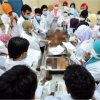
HEALTHCARE: International Islamic University of Malaysia’s teaching hospital, which will be ready in 2015, aims to be a syariah compliant facility to meet rising demand for such medical institutions
WHEN a Muslim woman was admitted to a University of Pittsburgh Medical Center-affiliated hospital in the United States recently for gastric bypass surgery, she was placed on a bed facing east — the qiblah — to allow her to perform her prayers.
The New York Times reported that the medical facility was one of a growing number of hospitals across America that had adopted “practices intended to improve care for an increasingly diverse patient population”.
The International Islamic University of Malaysia (IIUM) hopes to provide Muslim patients with this type of service at its teaching hospital when it is completed in 2015.
The hospital, which costs RM413 million, is located in Bandar Indera Mahkota in Kuantan, Pahang and will have some 300 beds.
It will be the fourth teaching hospital run by a public university in Malaysia after University of Malaya Medical Centre, Universiti Kebangsaan Malaysia Medical Centre and Hospital Universiti Sains Malaysia.
IIUM Kulliyyah of Medicine Basic Medical Sciences department head Professor Dr Pakeer Oothuman Syed Ahamed considers the setting up of the medical facility — some 15 years after the med school was established — long overdue.
“We are very happy and excited. All medical schools look forward to the day that they have their own teaching hospital,” he says.
His colleague Professor Dr Nasuruddin Abdullah shares his excitement.
“Having our own teaching hospital is like moving into our own home,” he says.
IIUM rector Professor Datuk Zaleha Kamaruddin agrees.
“We have received many requests to open a teaching hospital. What will set it apart from the rest is that it will be syariah compliant,” says Zaleha after a ceremony to lay the teaching hospital’s foundation stone.
Syariah compliance refers to an act or activity that obeys the requirements of Islamic law.
“A syariah compliant hospital is one that provides patients with, among others, halal healthcare products, amenities and staff trained to help patients and visitors to fulfil their religious obligations while at the hospital,” adds Zaleha.
Dr Nasuruddin believes IIUM staff and students are poised for the responsibility.
“Our students are well versed in teaching the ill to take ablutions,” he says.
He attributes students’ readiness for their role at the hospital to the courses conducted by IIUM-trained orthopaedic surgeons.
“Our students, in turn, train their peers from other universities,” he adds.
Zaleha concurs that IIUM’s teaching hospital is not the first to claim to observe Islamic law and practices.
However, few have been able to show proof of strict adherence to the rules.
“That is why we will have a team that will produce a clear guideline on what being syariah compliant means to the university. This will help the hospital stay true to its mission,” she says.
Kuantan campus director Professor Datuk Dr Kamaruzaman Wan Su, who will lead the group, aims to ensure that IIUM’s interpretation of syariah compliance goes beyond teaching incapacitated patients to pray on their hospital bed or building a surau for visitors.
“It is important to provide top quality service, which is demanded in Islam,” he says.
IIUM president Tan Sri Mohd Sidek Hassan agrees.
He envisions a teaching hospital that delivers quality yet affordable healthcare service to the public.
“Bear in mind that IIUM’s purpose (or raison d’être as he puts it) is to teach. So the teaching hospital will be a place for the staff and students to impart knowledge and practise medicine while serving the rakyat,” he says.
Sharing of expertise and facilities with neighbouring hospitals will be a norm.
“In fact, this is what we have been doing all along. Our faculty members are specialists in their areas and they have served local hospitals such as Tengku Ampuan Afzan Hospital,” says Mohd Sidek.
Zaleha hopes that the university’s pool of specialists from 40 nations will add value to the medical services provided in the East Coast in the future.
“We hope it will be a boost to medical tourism in Pahang,” she says.
Although the teaching hospital is still under construction, the university community already has big plans for it.
Zaleha lets on that there may be a private wing later on.
Kamaruzaman foresees the hospital growing beyond the initial 300 beds.
“(The hospital) is being built with the view to expansion. This is just the beginning,” he says.
Read more: Medical Schools: Spiritual care - Learning Curve - New Straits Times http://www.nst.com.my/channels/learning-curve/medical-schools-spiritual-care-1.196628#ixzz2KasrHpzy
Medical Schools: Spiritual care