The chemical signature of a person's exhaled breath is unique to that individual, according to a new study that suggests "breathprint" analysis may be a useful tool in testing health and disease, in much the same way as analysis of blood and urine.
Renato Zenobi and colleagues from the Swiss Federal Institute of Technology (ETH) and the University Hospital Zürich, Switzerland, write about their findings in the 3 April issue of the open access journal PLOS ONE.
Body fluids such as blood and urine carry a lot of chemical information about a person's health. Tests on these fluids help diagnose organ failure, infectious diseases and non-infectious diseases like cancer and metabolic conditions. They can also help doctors keep an eye on medication doses.
Now Zenobi and colleagues suggest that thanks to modern high-resolution analytical techniques that give results on the spot, the chemical information in a person's exhaled breath can be put to similar use.
Their approach uses modern technology to do what practitioners of traditional Chinese medicine (TCM) have been doing for a long time: diagnose the patient's state of health by smelling their exhaled breath.
There is also evidence that trained dogs and rats can distinguish among patients with different forms of cancer.
Using mass spectrometry, Zenobi, professor at ETH's Laboratory for Organic Chemistry, and colleagues, analyzed the exhaled breath of 11 people collected at different times of the day over 11 days.
They found a lot of variation in the chemical composition of exhaled breath not only across individuals, but also across samples from the same person taken at different times of the day.
However, within the variable pattern for each person they discovered a stable "core breathprint" that was highly specific and tied just to that person.
The pattern is largely based on volatile and semi-volatile metabolites.
Pablo Martinez-Lozano Sinues, senior scientist in Zenobi's research group, says in a statement:
"We did find some small variations during the day, but overall the individual pattern stays sufficiently constant to be useful for medical purposes."
Although the study did not investigate the biological reasons behind the unique metabolic breathprint, the researchers speculate that diet, state of health, illnesses and exposure to chemicals probably play a big part.
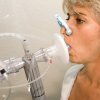
The mass spectrometers they used were modified versions of commercial machines, adapted with a mouthpiece that delivers the breath sample directly into the instruments' ion source.
Using this technology they could rapidly see the peaks from around 100 compounds. They were able to identify one of these as acetone, a product of sugar metabolism.
They are now working on identifying which compounds the other peaks belong to.
The researchers have two main goals for developing their technique further: one is to refine it as a tool for personal breathprints, and the other is to develop it as a tool for recognizing characteristic patterns of diseases.
For the latter, they are now working with a team at the Division of Pulmonology of the University Hospital Zurich, as Sinues explains:
"If we find a consistent pattern in patients with a given lung disease, we can develop a diagnostic tool."
The researchers see significant advantages in a reliable breathprint analyzer. For instance, unlike urine and blood tests, it would give results on the spot. It only takes a few seconds to see the pattern.
Another advantage is that it is completely non-invasive, no need for a needle as there is when the patient gives a blood sample. For the breath test the patient just exhales into the mouthpiece.
Co-author Malcolm Kohler, professor at the University Hospital Zurich, says:
"Our goal is to develop breath analysis to the point where it becomes competitive with the established analysis of blood and urine."
"Small, portable mass spectrometers already exist; if their performance can be improved, they will eventually find their way into clinics and doctor's offices," he adds.
source:medicalnewstoday
Chemical Signature Of Exhaled Breath Unique To Each Person